One of the most persistent misconceptions in options trading begins with a very simple event:
Money enters the account.
A trader sells a cash-secured put and receives $100.
A trader opens a credit spread and receives $50.
A trader sells a covered call and receives $150.
Because the transaction produces an immediate credit, it is tempting to think:
“I just made $100.”
But that is not what happened.
The trader received $100. Whether the trader made $100 is an entirely different question.
That distinction may seem like semantics, but it represents one of the most important concepts an options trader can understand.
A credit is cash received. Profit is the financial outcome of the trade.
Those two things are not interchangeable.
Why the Credit Feels Like Income
The misconception is understandable.
When we normally think about income, money comes into our possession. A paycheck is deposited. Interest is credited. A dividend appears in the account.
Option premium looks very similar.
Sell an option and the broker immediately credits the account.
That creates a powerful psychological effect. The trader can see the money and may begin thinking of it as something already earned.
This is particularly common with strategies frequently described as “income strategies,” including:
- Cash-secured puts
- Covered calls
- Credit spreads
- Iron condors
- The Wheel strategy
The terminology itself can reinforce the misconception.
“I generated $500 of income selling puts this week” sounds very different from:
“I collected $500 in option premium in exchange for assuming several contractual obligations.”
The second statement is much closer to what actually happened.
Premium Is Compensation for Assuming Risk
An option buyer does not simply hand money to the seller for no reason.
The buyer is purchasing a contractual right.
The seller receives money because the seller accepts the corresponding obligation and risk.
That means every option-selling transaction has two sides:
You receive something:
Premium.
You give something in exchange:
An obligation and the associated risk.
This is why the following statement is so important:
Premium is compensation for risk. It is not automatic profit.
A useful analogy is insurance.
An insurance company might collect a $2,000 premium to insure a property.
Did the company make a $2,000 profit the moment it received the premium?
Of course not.
It received $2,000 in exchange for assuming a financial obligation. If no covered loss occurs, some of that premium may ultimately become profit. If a large claim occurs, the insurer can lose far more than the premium it collected.
Selling options operates on a similar principle.
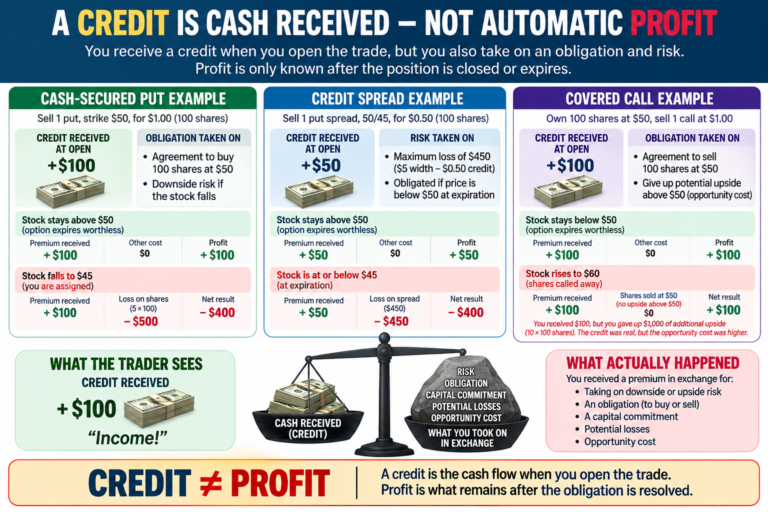
A Simple Cash-Secured Put Example
Suppose a stock is trading near $50.
You sell one $50 cash-secured put for $1.00.
Because an option contract normally represents 100 shares, you receive:
$1.00 × 100 = $100
Your account receives a $100 credit.
Have you made $100?
No.
You have received $100 in exchange for agreeing to purchase 100 shares for $50 if the option is exercised.
Your effective breakeven at expiration is:
$50 strike − $1 premium = $49
Now suppose the stock falls to $45.
You can be assigned 100 shares at $50 even though those shares are worth only $45.
The economic result at that point is:
Premium received: +$100
Loss on shares relative to the $50 purchase price: −$500
Net result: −$400
The original $100 credit was real.
The $100 profit was not.
This is precisely why credit received and profit earned must be treated as separate concepts.
The Same Problem Exists With Credit Spreads
Suppose you sell a $5-wide put credit spread for $0.50.
You immediately receive:
$50
It is easy to look at that transaction and say:
“I made $50.”
But you haven’t.
You have received $50 while accepting a maximum potential loss of:
$500 spread width − $50 credit = $450
If the spread expires fully in the money, your result is approximately:
Credit received: +$50
Loss associated with the spread: −$500
Net result: −$450
Again, the credit was merely one component of the transaction.
The direction of the opening cash flow told you nothing by itself about whether the transaction would ultimately be profitable.
Covered Calls Create Another Version of the Illusion
Covered calls make the issue more subtle.
Suppose you own 100 shares of a $50 stock and sell a $50 call for $1.
You receive $100.
If the stock remains below $50 and the option expires worthless, the $100 premium can contribute positively to your overall return.
But suppose the stock suddenly rises to $60.
Your shares can be called away at $50.
You still received the $100 option premium, but you surrendered the appreciation above your strike price.
The covered call didn’t necessarily create a realized loss. But the $100 credit came with an economic cost: you sold away some of the stock’s upside potential.
That is why covered-call analysis should not stop at:
“How much premium can I collect?”
The better question is:
“What am I giving up or risking in exchange for this premium?”
This Is Especially Important With the Wheel
This misconception becomes particularly dangerous when discussing the Wheel strategy.
The Wheel is often described approximately like this:
Sell puts → collect income → get assigned → sell calls → collect more income → repeat.
Presented that way, it can sound almost mechanical.
Every step seems to produce another credit.
But a sequence of credits does not guarantee a profitable strategy.
Imagine collecting:
+$100 selling a put
+$90 selling another put
+$110 selling a covered call
+$100 selling another covered call
A trader might say:
“I’ve generated $400 of income.”
Perhaps.
But what happened to the underlying stock?
If the trader was assigned shares at $50 and the stock is now trading for $40, there is a $1,000 unrealized decline in the stock position.
Looking only at premiums would produce a completely distorted picture:
Premium collected: +$400
Stock decline: −$1,000
Economic position: −$600
Collecting premium did not eliminate risk.
It merely offset part of the loss.
Cash Flow Is Not P&L
The fundamental accounting concept is remarkably simple:
Cash flow tells you where money moved.
Profit and loss tells you whether you became economically better or worse off.
An opening credit tells you the direction of the initial cash flow.
It does not tell you the profitability of the trade.
This is also why I believe traders should be careful with language.
Instead of saying:
“I made $500 selling puts this week.”
Consider saying:
“I collected $500 in option premium this week.”
Then ask the much more important question:
What was my total P&L?
That forces us to consider the entire position rather than focusing on the most psychologically appealing part of it.
Debit Does Not Automatically Mean Bad and Credit Does Not Automatically Mean Good
There is another important lesson hidden inside this discussion.
Traders sometimes develop an instinctive preference for credits because receiving money feels better than paying money.
But whether a trade opens for a debit or credit tells us surprisingly little about whether it is a good trade.
Consider two transactions:
Trade A: Receive a $100 credit with $900 at risk.
Trade B: Pay a $400 debit with the possibility of receiving $500 at expiration.
Which is better?
There isn’t enough information to answer.
We would need to know probabilities, breakevens, expected returns, market assumptions, liquidity, transaction costs and other factors.
The fact that one transaction begins with money entering the account and the other begins with money leaving the account does not establish which has the better expectancy.
This is especially important when comparing economically similar debit and credit spreads.
The opening cash-flow direction should never substitute for analysis.
Ask What You Are Receiving—and What You Are Giving Up
Whenever an option trade produces a credit, ask two questions:
1. What am I receiving?
Premium.
2. What am I accepting or surrendering in exchange?
That might include:
- Downside risk
- Assignment risk
- Capital commitment
- Maximum potential loss
- Upside opportunity
- Liquidity risk
- Early-assignment risk
- Transaction costs
Only after considering both sides of the transaction can the economics of the trade be evaluated properly.
The Better Mental Model
Instead of thinking:
CREDIT = INCOME
Think:
CREDIT = COMPENSATION FOR AN OBLIGATION
And instead of asking:
“How much premium can I collect?”
Ask:
“How much am I being paid relative to the risk I am accepting?”
That is a dramatically different way of thinking about option selling.
It shifts attention away from the excitement of receiving premium and toward the economics of the entire trade.
The Bottom Line
There is nothing inherently wrong with selling options.
There is nothing inherently wrong with cash-secured puts, covered calls, credit spreads or the Wheel.
Each can be useful when applied appropriately.
The problem begins when premium collection is confused with profit generation.
A $100 credit is unquestionably $100 of cash received.
But it is not automatically $100 of income earned.
The trade still has an obligation attached to it. It still has risk. Its ultimate economic result remains uncertain.
The simplest way to remember the distinction is:
A credit is the cash flow when you open the trade. Profit is what remains after the obligation is resolved.
Or even more simply:
CREDIT ≠ PROFIT
Receiving money is the beginning of the transaction.
Profit is the outcome.