Catching the Wave: How to Spot the “First Signal” of a New Trend
Introduction: The “Early Bird” Dilemma in Trading
For most market participants, the greatest psychological hurdle is not the lack of opportunity, but the pain of the “late entry.” We often identify a powerful trend only after the primary impulse has concluded, leaving us to chase the tail-end of a move with a suboptimal risk-reward profile. This “FOMO-driven” approach is the antithesis of professional trading. To solve this, technical analyst Joe Rabil utilizes a specific price-oscillator confirmation known as “The First Signal.” This strategy provides a mathematical cure for late-cycle chasing by identifying the “birth” of a momentum regime—the precise moment a security transitions from a range or downtrend into a fresh, high-probability advance.
Takeaway 1: The “First Hold” of the 18-Period Moving Average
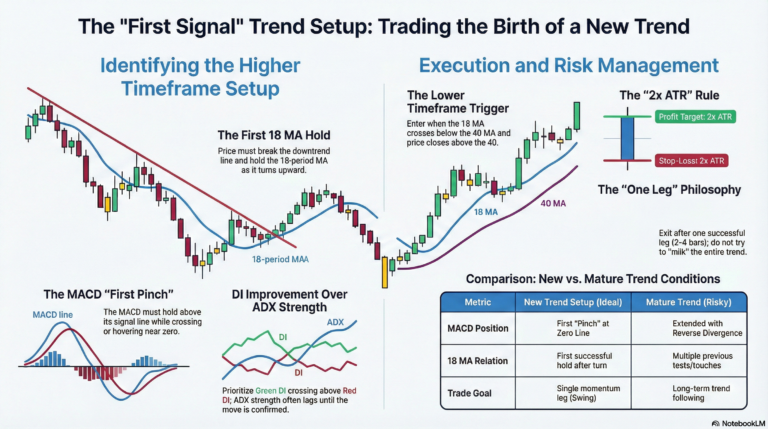
The prerequisite for this setup is a fundamental “character change” in price action. The asset must first break a significant downtrend line or exit a sideways consolidation. Once this breakout occurs, we are searching for the initial instance where the price “digests the move” by pulling back to the 18-period moving average.
This “first hold” is technically more significant than any subsequent test. It represents the first successful defense of the new trend by institutional buyers. While a mature trend may return to the 18-period average multiple times, the initial pullback offers the cleanest velocity because the momentum is newborn and the “crowded trade” effect hasn’t yet taken hold. As Joe Rabil observes: “We want to make sure we’re pulling back towards the 18… where we hold the 18 for the first time in a new trend.”
Takeaway 2: The MACD Signal Line “Pinch” is Non-Negotiable
To filter out false breakouts, the strategy relies on a specific behavior within the MACD (Moving Average Convergence Divergence) known as a “pinch.” For the trade to be valid, the MACD must hold above its signal line throughout the entire price pullback.
- Momentum Confirmation: A MACD signal line hold indicates that while the price is undergoing a time-based correction, the internal momentum has not rolled over.
- The “Complexity” Filter: If the MACD breaks below the signal line, the trend transition becomes “complex.” This implies a potential Zero Line Reversal or a deeper mean-reversion process, which disqualifies the “quick swing” logic of the First Signal.
- Zero-Line Alignment: Ideally, this pinch occurs as the MACD crosses or hovers near the zero line, signaling the early shift from a bearish to a bullish momentum regime.
Rabil emphasizes the necessity of this alignment: “For this specific pattern we are looking for when the MACD holds the signal line… third thing we like to see is that this is the first signal as we’re crossing above the zero line.”
Takeaway 3: Mastering the Lower-Timeframe “Overrun”
Execution requires a two-timeframe alignment—typically comparing a Weekly chart for the trend with a Daily chart for the entry. On the higher timeframe, we see the price holding the 18-period average; however, we look for a deliberate “overrun” on the lower timeframe to shake out weak hands.
On the lower (execution) timeframe, the 18-period average will often cross below the 40-period moving average. For a high-quality setup, the price should actually close below both the 18 and 40 MAs. This creates a “zone” of uncertainty where the price might “fiddle around.” We can remain lenient regarding this overrun because the higher-timeframe momentum is newborn.
The Entry Trigger: The trade is activated only when the price stabilizes and produces a decisive close back above the 40-period moving average on the lower timeframe.
Takeaway 4: Technical Confirmation via DI/ADX
A secondary, yet vital, confirmation tool is the Directional Index (DI). Because the trend is “newborn,” the ADX (Average Directional Index) may not yet be above the 25-level threshold that signifies a strong trend. However, we must see a clear “improvement” in the DI relationship. Specifically, the Green DI (+DI) should cross above the Red DI (-DI) and—crucially—hold above the Red DI throughout the entire pullback. This ensures that even while the price is resting, the bullish directional pressure remains dominant over the bearish pressure.
Takeaway 5: Trading the “Single Leg” with 2x ATR
Unlike “trend-following” strategies that attempt to milk a move for months, the First Signal is a precision strike designed to capture one clean swing. The expectation is immediate follow-through, typically realizing the target within a 2 to 4 bar window (e.g., 2 to 4 weeks on a weekly chart).
Risk Management Parameters:
- Stop Loss: 2x the Average True Range (ATR) of the entry timeframe. This volatility-based stop is often wider than a structural swing-low stop, providing the “breathing room” necessary for a newborn trend to find its footing.
- Profit Target: 2x the ATR.
By taking profits at this level, traders avoid the volatility of a maturing trend. Rabil notes: “We’re only looking to make a move from here to there… we’re not trying to milk the trade and turn it into a big trending move.”
Takeaway 6: Why “Newborn” Trends Beat “Mature” Ones
The reliability of the “pinch” play is highest at the trend’s inception. As a move becomes mature and “crowded,” the price-oscillator relationship degrades. Traders should be wary of Reverse Divergence, a classic sign of trend exhaustion where the price makes a Higher Low, but the MACD makes a Lower Low. This signal suggests that the underlying momentum is no longer supporting the price structure. By focusing exclusively on the “First Signal,” we capitalize on the period of maximum technical clarity and momentum velocity.
Conclusion: The Power of the Shift
The “First Signal” strategy is a masterclass in timeframe alignment and momentum filtering. Whether applied to 1-minute scalping or weekly swing trading, its power lies in its ability to identify the exact moment the market “shifts gear.” Success in the markets is often a function of patience—the ability to ignore the noise of a dying trend while waiting for the technical birth of a new one.
Are you willing to wait for the “first signal” of a new trend, or will you keep chasing the momentum of the old one?