Build a Repeatable Trading Process
Consistent trading begins with a consistent process. Rather than making each trade as an isolated decision, a defined workflow provides a framework for finding opportunities, evaluating risk, structuring trades, executing orders and reviewing results.
The goal isn’t to predict what the market will do next. It’s to make each trading decision using a repeatable process that can be measured, evaluated and continuously improved.
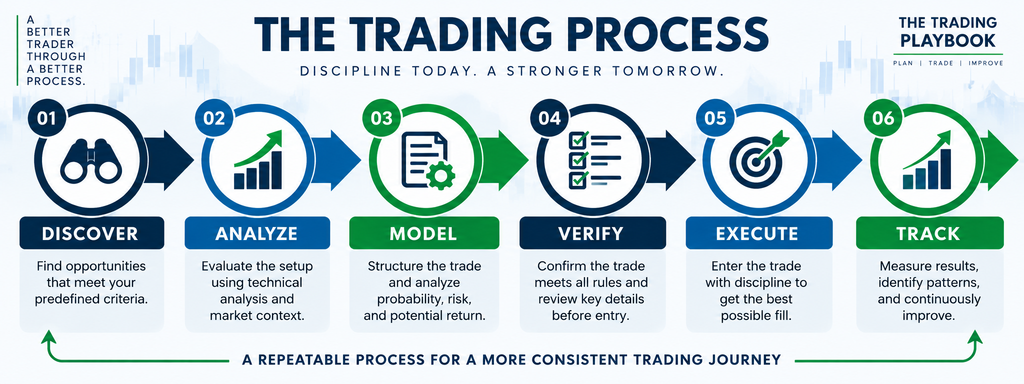
1. Discover the Opportunity
The trading process begins by identifying opportunities that meet predefined criteria. Rather than searching for a trade to make, the objective is to find candidates that deserve further analysis.
Screening helps narrow a large universe of stocks and options into a manageable list of potential setups based on factors such as trend, liquidity, volatility, price behavior and strategy requirements.
- Trend — Is the underlying moving in a direction that supports the trade?
- Liquidity — Does the stock and its options have sufficient trading activity?
- Volatility — Are current volatility conditions appropriate for the strategy?
- Strategy Fit — Does the opportunity meet the basic requirements of the trading setup?
The goal of discovery is not to find a trade. It is to find something worth analyzing.
2. Analyze the Setup
Once a potential opportunity has been identified, the next step is to evaluate the underlying price action and market context. Technical analysis is used to determine whether the setup supports the direction and structure of the proposed trade.
The objective is not to predict exactly where price will go. It is to identify the trend, important price levels and conditions that may affect the probability of success.
- Trend Structure — Evaluate the direction and strength of the prevailing trend.
- Support & Resistance — Identify price levels that may provide support for bullish trades or resistance for bearish trades.
- Price & Momentum — Look for confirmation that price behavior and momentum support the proposed direction.
- Market Context — Consider broader market conditions and whether they support or conflict with the setup.
- Upcoming Events — Check earnings and other known events that could materially change the risk of the trade.
Analysis provides context. It does not create the trade—the numbers still have to work.
3. Model the Trade
A favorable chart does not automatically make a favorable trade. Once the setup passes technical analysis, the proposed position should be modeled to understand its probability, potential return and risk before any capital is committed.
This is where the underlying idea is converted into a defined trade structure. Expiration, strikes and position size can be adjusted to determine whether the opportunity meets the requirements of the strategy.
- Expiration (DTE) — Select an expiration appropriate for the strategy and expected duration of the trade.
- Strike Selection — Choose strikes that create the desired balance between probability, return and risk.
- Probability of Profit — Estimate the likelihood that the position will finish profitably.
- Breakeven — Determine how much room the underlying has before the trade becomes unprofitable at expiration.
- Maximum Profit & Risk — Know the defined potential gain and loss before entering.
- Return on Investment — Measure the potential return relative to the capital at risk.
- Expectancy — Evaluate whether the combination of probability, potential gains and potential losses produces a favorable long-term expectation.
A trade should earn its way into the portfolio through the numbers—not simply because the chart looks attractive.
4. Verify the Trade
Before submitting an order, pause and verify that the trade still meets the rules of the strategy. This final review helps prevent a promising setup from becoming a poor trade because of an overlooked detail, incorrect assumption or unnecessary risk.
Verification should be systematic. The same questions should be answered before every trade so that decisions remain consistent rather than changing with emotion or market excitement.
- Strategy Rules — Confirm that the trade meets all required entry criteria.
- Risk & Position Size — Verify that the capital at risk is appropriate for the account and trading plan.
- Liquidity & Pricing — Review the bid/ask spread and option liquidity to determine whether the position can be executed at an acceptable price.
- Breakeven & Price Levels — Confirm that the breakeven and critical strikes are positioned appropriately relative to support, resistance and the current stock price.
- Events & Expiration — Recheck earnings, expiration and other known events that could affect the position.
- Exit Plan — Know the conditions for taking profits, reducing risk or closing the position before entering it.
If the trade doesn’t meet the rules before entry, execution shouldn’t make it a trade.
5. Execute the Trade
Once a trade has passed the discovery, analysis, modeling and verification stages, the focus shifts to execution. The objective is not simply to get filled—it is to enter the position at a price that preserves the economics of the trade.
Option prices can change quickly, and quoted markets do not always represent the price at which a spread can actually be executed. Using disciplined order-entry practices helps prevent impatience from turning a good setup into a poor trade.
- Use Limit Orders — Define the maximum debit or minimum credit you are willing to accept rather than surrendering control of the execution price.
- Evaluate the Market — Consider the bid, ask and midpoint, while recognizing that displayed prices may not reflect the actual executable market for a multi-leg spread.
- Protect the Trade Economics — Make sure the execution price still provides an acceptable return, breakeven and risk profile.
- Avoid Chasing — If the trade cannot be filled at an acceptable price, be willing to wait or move on to another opportunity.
- Confirm the Fill — Once executed, verify the actual fill price, position size and contract details before moving to trade management.
A good setup does not require a bad fill. If the price changes the economics of the trade, the trade has changed.
6. Track the Results
The trading process does not end when the position is closed. Every completed trade provides information that can be used to evaluate the strategy, identify patterns and improve future decisions.
Tracking results turns individual trades into useful data. Over time, that data can reveal what is working, what is not and whether actual performance matches the assumptions used when the trades were originally modeled.
- Record the Trade — Document the setup, entry price, position size, expiration, strikes and outcome.
- Measure Performance — Track metrics such as win rate, ROI, days held, profit and loss, and expectancy.
- Review Execution — Compare intended prices with actual fills and evaluate the effect of execution on returns.
- Identify Patterns — Look for recurring characteristics among both successful and unsuccessful trades.
- Evaluate the Strategy — Determine whether actual results continue to support the assumptions behind the trading approach.
- Refine the Playbook — Use evidence from completed trades to improve rules, filters and execution without constantly changing the strategy based on a handful of outcomes.
The purpose of tracking isn’t simply to record what happened. It’s to make the next decision better informed than the last.
Turn the Process Into Your Playbook
A trading process becomes valuable when it is followed consistently. Individual trades will always contain uncertainty, but the decisions surrounding those trades do not have to be random.